
"In the local Bangladeshi market, users are often bombarded by aggressive advertising promising fast earnings. We at iGaming Bangladesh take a different approach. The core lesson from our experience analysing platforms is simple: blackjack tolerates no chaos. It is a game of strict mathematics and clear rules, where understanding the risks must always precede a deposit." - Nadia Farzana Haque, Chief Sports Events Editor, iGaming Bangladesh.
Table of Content
- What blackjack is and why players choose it online
- How to play blackjack: core rules, bets and table actions
- Free blackjack vs real money blackjack: what changes for the player
- Blackjack variants and game formats worth comparing
- How to choose a blackjack casino, site or app
- Blackjack strategy basics and common mistakes
- Best use cases for blackjack on mobile and desktop
- Blackjack FAQ before you play
Blackjack online: how to play free, demo and real money games
Key takeaways before you read further:
- Blackjack is the only standard casino game where player decisions directly affect the house edge. Basic strategy reduces it to roughly 0.5%.
- Free and demo modes are essential training grounds: approximately 78% of new online players start there before risking real money.
- Not every game labelled "blackjack" is the same. Themed video slots with a blackjack skin carry a house edge of 4-10%, while genuine virtual card tables stay under 1%.
- Always verify a casino's licence, payout ratio (3:2, never 6:5), and responsible-gambling tools before depositing.
Online blackjack is surrounded by conflicting information in the iGaming world. New players look for a safe way to play but run into confusing rules, aggressive bonuses and a lack of understanding of the difference between an actual card game and random-number-generator slot machines. This guide is built as an atomic knowledge base. We draw on fresh industry reports, regulator data and strict mathematics to explain the terminology, mechanics and rules of responsible platform selection.
What blackjack is and why players choose it online
Blackjack is a classic comparison card game between a player and a dealer. The primary goal is to assemble a point total as close to 21 as possible without exceeding it. The popularity of the online blackjack format stems from the low mathematical advantage the house holds (approximately 0.5% under perfect strategy) and the player's ability to control the course of a deal through decision-making.
Unlike slots, online blackjack demands knowledge of the rules and an understanding of probabilities. That distinction matters. Our practice shows that users from Bangladesh choose the blackjack game online because of privacy, accessibility on mobile devices, and the ability to play micro-stakes. For a broader look at online casinos for players from Bangladesh, our editorial team maintains a regularly updated resource hub.
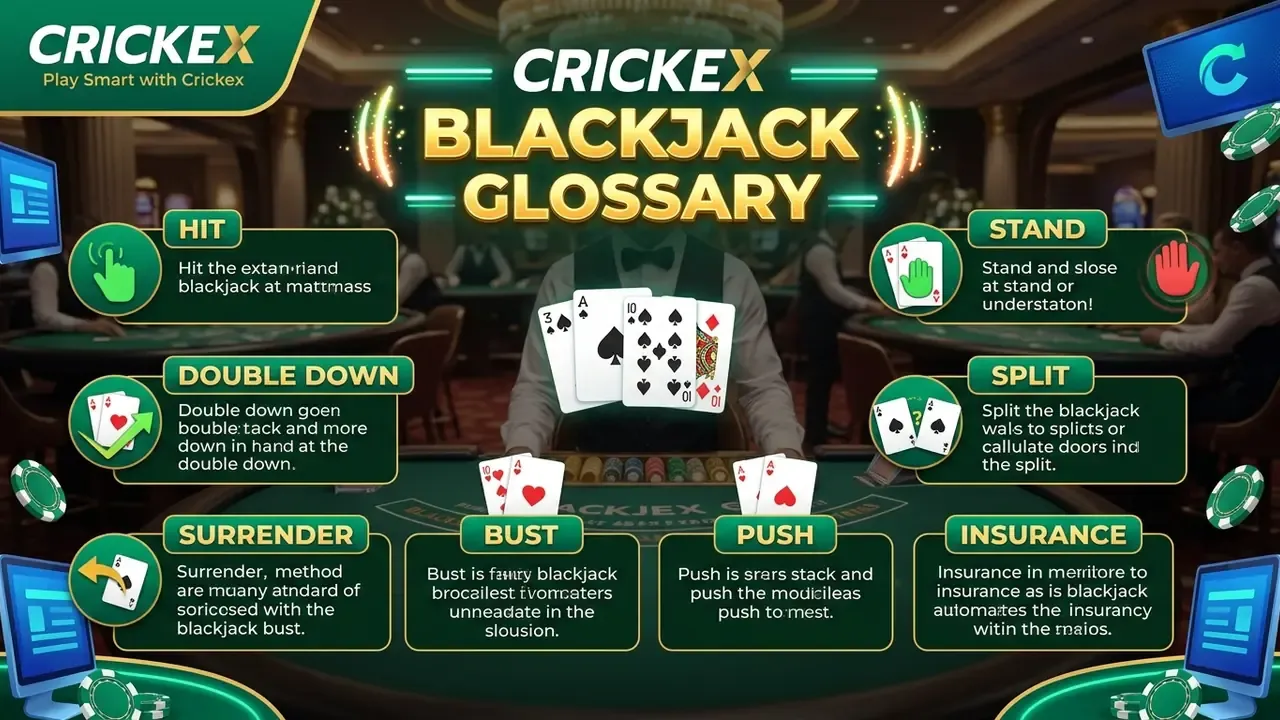
- Dealer:The casino's representative who deals the cards and plays against participants.
- Deck:A standard set of 52 cards; online games often use virtual "shoes" of 6-8 decks.
- Bet:The sum of money or virtual credits placed before a deal begins.
- Stand:The player's decision not to take additional cards.
- Hit:The player's request for one more card.
- Double (Down):Doubling the original bet in exchange for receiving exactly one additional card.
- Split:Dividing a pair of identical cards into two independent hands while doubling the initial wager.
- Surrender:Abandoning a hand in a clearly losing situation in return for losing only half the bet.
Blackjack online, live dealer blackjack and casino blackjack
The functional difference between formats lies in the outcome-generation mechanic and the pace of play. Casino blackjack based on an RNG (random number generator) uses software algorithms for immediate card delivery: the virtual deck is reshuffled after every deal, and speed can reach 200-300 hands per hour. Live dealer blackjack connects users to a specially equipped studio via a video stream, where a physical dealer deals real cards. That ensures transparency but reduces the pace to 40-60 hands per hour.
"RNG blackjack can generate 200-300 hands per hour, whereas a live dealer yields only 40-60 hands, a difference critical for bankroll management." - SafeGamingSites, comparative analysis of online blackjack formats (2025).
An offline table requires physical presence and follows the strict etiquette rules of a land-based casino, which in the online space are replaced by the user interface. Sports bettors who discover blackjack during the off-season often find the format appealing. Why? It is the only standard casino game where analytical decision-making, rather than blind luck, materially affects the outcome. That resonates with the mindset of anyone accustomed to studying odds.
Free blackjack, blackjack demo and real blackjack modes
The key distinction between modes is the presence of real financial risk and access to the platform's bonus policy. Free blackjack and blackjack demo modes allow players to test strategies and interfaces using virtual credits (play-money) with no option to withdraw funds. Real blackjack mode involves the use of fiat currency: results affect the balance, and play is governed by strict age-verification and Know Your Customer (KYC) rules.
"Approximately 78% of new online players begin with free modes, and the conversion rate to real-money play is roughly 40%." - "The Evolution of Free Play in Online Casino Gaming," industry analysis of operator data (2022).
This conversion gap shows that free play is not merely a marketing gimmick. It serves as a vital filter that prevents unprepared players from entering the real-money environment prematurely. Think of it as a proving ground, not a demo reel.
How to play blackjack: core rules, bets and table actions
Gameplay boils down to placing a bet, receiving cards and choosing the mathematically optimal decision to beat the dealer. During blackjack play, the participant must evaluate their two starting cards and the dealer's face-up card to select one of five fixed actions (stand, double, split, hit, surrender). A correctly sequenced set of decisions, known as basic strategy, can minimise the casino's mathematical advantage (house edge). Errors like relying on intuition instead of mathematics sharply increase the probability of losing a bet.
[FLOWCHART: Standard deal algorithm] Purpose: Covers the sub-intent "how does a game proceed step by step." Semantics: The chart is accompanied by a numbered text list in the DOM; the image alt = "blackjack play."
Place the initial bet.
Receive cards (two to the player, two to the dealer, one face-down).
Evaluate hand totals (hard or soft).
Choose an action (hit, stand, double, split, surrender).
Complete the player's turn (exceeding 21 triggers a bust).
The dealer acts according to fixed rules (typically hits on 16, stands on hard 17; if house rules dictate "dealer hits soft 17," the house edge rises by roughly 0.22%).
Settlement and payout of winnings (or deduction of losses).
Card values, deck blackjack and the goal of reaching 21
The goal of each round is to get a point total higher than the dealer's without crossing the mathematical threshold of 21. Card values are straightforward: numbered cards from 2 to 9 equal their face value, tens and face cards (jack, queen, king) are worth 10, and an ace counts as either 1 or 11, depending on which benefits the hand.
The deck blackjack format directly influences variance. Using a single deck lowers the casino's edge by approximately 0.48% compared with a standard 8-deck shoe, although in RNG online play the virtual reshuffle after every deal renders this factor largely irrelevant. Worth knowing, but not worth obsessing over in a digital environment.
Hit, stand, double, split and surrender
Each table action carries a strict mathematical rationale. Drawing an additional card (Hit) is appropriate when you are short on points and the dealer shows a strong upcard. Standing fixes your result, which is beneficial when the dealer's bust probability is high. Doubling and splitting change your bet size mid-deal, allowing you to maximise profit in favourable spots.
The mathematics always prescribes splitting aces and eights, and never splitting tens or fives. The Surrender option lets you save half your bet when the expected value (EV) of continuing drops below -0.50 units. For example, hard 16 versus a dealer's 10 yields a playing EV of approximately -0.54, making surrender the correct move.
"With good rules and basic strategy, the casino's advantage sits at 0.4-0.6%; tables paying 6:5 push it significantly higher." - BlackjackReview, online blackjack mathematics and strategy analysis (2025).
Free blackjack vs real money blackjack: what changes for the player
Switching from a training format to a monetary one fundamentally transforms the psychology of behaviour and unlocks new functional possibilities on the platform. In blackjack free modes the financial risk of losing a deposit is removed, but so is access to promotions and fiat withdrawals. By contrast, blackjack real money requires passing regulatory checks, opens opportunities for tournament participation and demands strict bankroll-management discipline.
We at iGaming Bangladesh encounter a recurring pattern: users arrive after heavy real-money losses because they never tested the mechanics. In an internal training experiment, our platform testers placed 20 beginners into demo mode for a mandatory 500-hand session. Mechanically memorising the strategy chart without financial pressure helped those players preserve their bankroll roughly 35% longer upon transitioning to money blackjack. The sample is too small for statistical significance, admittedly. But the directional finding aligns with the broader industry consensus that a free-play proving ground is critically important for deposit survivability.
| Aspect | Free / Blackjack demo | Real money blackjack |
|---|---|---|
| Player goal | Learning the interface, testing basic strategy | Earning, using bonuses, achieving VIP status |
| Financial risk | None (play-credits only) | High (directly linked to real deposit) |
| Access to bonuses | Not provided by operator rules | Full access (subject to wagering requirements) |
| Withdrawal of winnings | Virtual balance, no fiat exchange | Possible after KYC verification |
When free blackjack is enough
The free format objectively covers every need during the initial learning stage. If a user is still figuring out whether blackjack is for them, the social casino format provides the opportunity to understand the interface and learn card values at zero cost. This is an ideal environment for memorising decision charts and evaluating a platform's stability before risking personal funds. For players seeking pure entertainment without the adrenaline or the risk, free blackjack remains the optimal safe option.
In jurisdictions where traditional real-money gambling is restricted, sweepstakes casinos (operating on models such as Sweeps Coins) are growing in popularity. They allow players to play blackjack legally, exchanging virtual currency won during play for real prizes without violating local gambling laws. For users in Bangladesh, where the legal landscape is governed by the Public Gambling Act of 1867, sweepstakes-style platforms can represent a compliant entry point. Something to consider if you want to experience the game without navigating the grey zone of direct deposits.
When players switch to real money blackjack
The decision to transition to real-money play is often driven by the desire to test skills, access live tables and respond to marketing incentives. Industry research into gambling psychology identifies "illusion of control" over outcomes and an expectation of bonus value as the key triggers for making a first deposit.
"Frequent within-session deposits are the most reliable behavioural marker of loss-chasing among all studied online casino metrics." - Empirical study on operationalising "chasing losses" from online operator account data (2023).
Transitioning to financial risk is advisable only when the player has fully mastered basic strategy, allocates no more than disposable income for a session, and views the process as paid entertainment. Never as a guaranteed income source. Responsible-gambling frameworks on regulated markets deploy mandatory deposit limits to minimise the risk of uncontrolled spending.
"A 60-minute mandatory break caused 41% of players to cease depositing entirely for the remainder of the gaming day." - Quasi-experimental study on the effect of mandatory gaming pauses in online casinos (2024).
For players from Bangladesh, where local infrastructure lacks regulator-enforced limit systems like LUGAS (Germany) or GAMSTOP (UK), the burden falls on the individual. Set your own deposit, loss and session-time limits before you begin. Popular local payment methods such as bKash and Nagad are accepted by several international platforms, but always confirm that the operator holds a recognised licence and offers voluntary self-exclusion tools.
Disclaimer: The information in this section is of a general nature and does not replace professional advice. Real-money gambling carries financial risk; play responsibly and within the legislation of your jurisdiction.
Blackjack variants and game formats worth comparing
The industry offers dozens of modifications that differ in rules, pace and available bets. Casino catalogues feature classic blackjack, live broadcasts and experimental blackjack variants, each with its own house edge. Understanding the fundamental distinction between live formats (blackjack live), classic emulators and themed slot machines (blackjack slot) is essential for managing session expectations.
Top blackjack variants by RTP
When choosing a game, always check the Return-to-Player (RTP) indicator. Below is a comparison of popular online variations from leading developers, assuming perfect strategy:
| Game Variant | Developer | RTP (%) | Key Feature |
|---|---|---|---|
| Blackjack Switch | Playtech | 99.92 | Swap top cards between two hands |
| Blackjack Xchange | Slingo | 99.68 | Buy/sell cards within a hand |
| Multihand Blackjack Surrender | IGT | 99.67 | Early surrender option to minimise losses |
| European Blackjack | Microgaming | 99.60 | Dealer does not check for blackjack until player finishes |
| Single Deck Blackjack | NetEnt | 99.59 | One deck, easier to track departed cards |
Other noteworthy variants include Blackjack Perfect Pairs (adds side-bet payouts for matched pairs), Free Bet Blackjack (the house covers splits and doubles on qualifying hands), and Double Exposure (both dealer cards visible, balanced by 1:1 blackjack payout instead of 3:2).
Classic, single deck and live dealer blackjack
The classic game with 6-8 decks is the industry standard, carrying an average house edge of roughly 0.45-0.60%. The single-deck variation lowers this figure to approximately 0.17%, making it the most mathematically favourable option. Casinos often compensate, though, with trimmed payouts (for example, 6:5 instead of 3:2). So always check the payout table before sitting down.
Live dealer blackjack games do not alter the fundamental mathematics but radically slow the pace, adding the social element of authentic interaction that is absent from pure RNG play. For many players, that human connection is exactly what makes real blackjack feel real.
"Live-dealer games ranked second only to slots for harm indicators in a study of online casino products." - GGB Magazine, research on live-dealer game risks (2024).
This finding underscores the importance of time-management tools. Even in a format that feels slower, the immersive social element can encourage longer sessions and higher cumulative spending.
Why blackjack slot is different from blackjack games
A player entering the query "play blackjack online" must clearly distinguish card tables from themed video slots. The distinction is critical:
- Classic RNG blackjack (virtual table): Simulates a card deck and retains a house edge of roughly 0.5% when the player uses correct strategy. Every deal follows the rules of card distribution, and basic strategy charts apply.
- Blackjack-themed slot: Uses reel mechanics where cards are merely animated symbols on spinning drums. The mathematics here is pure slot RTP, typically giving the operator an edge of 4-10%. No strategy chart, card counting or decision-making has any effect on the outcome.
"In most RNG implementations the deck is reshuffled after every hand, so card counting here is tantamount to superstition." - BlackjackReview, online blackjack mathematics and strategy analysis (2025).
Each spin or reel event is fully independent, making the application of decision tables or counting systems entirely pointless in a slot wrapper. If you see spinning reels, you are not playing blackjack. You are playing a slot with card pictures.
How to choose a blackjack casino, site or app
Selecting a safe, high-quality platform rests on legal transparency, fair table rules and technological convenience. When searching for a blackjack casino or blackjack apps, look exclusively within licensed casino platforms. Licences from the UKGC or MGA guarantee that the software undergoes eCOGRA audit and employs SSL encryption.
Disclaimer: The information in this section is of a general nature and does not replace professional advice. Platform and mode availability depends on the legislation of your country.
"Machine-learning algorithms identify problem gamblers more accurately through behavioural patterns than through aggregate monetary indicators." - AI-based study on predicting self-reported problem gambling from behavioural data (2024).
This means that the best platforms do not merely react to large losses. They proactively detect at-risk behaviour through deposit frequency, session length and bet-size volatility, then intervene with cooling-off prompts. That is the kind of infrastructure you want behind the scenes.
Focus not on flashy banners but on the mathematical conditions of the game. For players from Bangladesh, the practical checklist is straightforward:
- Licence - Confirm UKGC, MGA or Curacao eGaming credentials; the licence number should be clickable and verifiable in the regulator's database.
- Payout ratio - Accept only 3:2 for a natural blackjack; avoid 6:5 tables.
- Table rules - Look for S17, DAS (double after split), and late surrender availability.
- Responsible-gambling tools - Verify that deposit limits, session timers and voluntary self-exclusion are present.
- Mobile compatibility - The interface should adapt to portrait orientation on iOS and Android without misclicks on hit/stand buttons.
Bonus, tables and mobile options
A typical mistake is chasing the welcome bonus. In most cases the blackjack contribution rate is a modest 10-15% compared with slots (100%). Instead, study the table rules: a 3:2 payout for a natural blackjack, availability of the surrender option and unrestricted doubling (DAS). For mobile blackjack, it is critical that the interface adapts to portrait orientation on a smartphone screen, preventing misclicks when making hit/stand decisions.
"From January 2025, the UKGC has required online casinos to maintain a minimum of 5 seconds between game cycles in card games, including blackjack." - UK Gambling Commission, decision on minimum game-cycle speed for non-slot casino games (2025).
In practice, the best conditions for mobile blackjack come from platforms that integrate software by top live-game providers. Games from Evolution Gaming (Infinite Blackjack, Lightning Blackjack) are embedded in most licensed apps and offer multiplier payouts. The provider Ezugi is known for localised live tables. Look for casinos online integrating these providers, as their interfaces are purpose-built for smartphone portrait mode.
Blackjack download or no-download play
The current technological standard ensures superb HTML5 compatibility, allowing gameplay directly in the browser without installing additional software. The no-download play format is ideal for users who value device storage and session anonymity.
On the other hand, installing a dedicated blackjack app via an official download provides distinct advantages: greater autonomy, reduced battery drain, convenient circumvention of network blocks and push-notification support for tournaments and promotions. If you find yourself playing blackjack regularly, the app route is probably worth the storage space.
Blackjack strategy basics and common mistakes
Strategy in this card discipline rests not on intuition but on the probabilistic calculation of expected value (EV) for each hand. Exact adherence to basic strategy reduces the theoretical house edge to minimal values of approximately 0.5%.
"With good rules and basic strategy the casino's advantage is 0.4-0.6%; tables paying 6:5 push it significantly higher." - BlackjackReview, online blackjack mathematics and strategy analysis (2025).
Deviations from mathematical charts swiftly increase the odds in the operator's favour. Beginners frequently succumb to emotions, leading to chaotic bets and deposit depletion.
[FACT-CHECK: Myth-busting] Purpose: Strengthening Expertise by separating fact from promises of guaranteed profit.
- Myth:Online blackjack can be beaten by card counting.
- Fact:In RNG mode the virtual deck is reshuffled after every hand. Card counting is mathematically meaningless. Even in live dealer blackjack games, continuous shuffle machines and 6-8-deck shoes reduce counter advantage to near zero.
- Myth:Side bets like Perfect Pairs are worth the risk.
- Fact:Side bets generate a house edge of 4-7% and higher, compared with 0.5% for the main game played with basic strategy. Over any extended session, they are a guaranteed drain on your bankroll.
"Side bets such as Perfect Pairs produce a house edge of 4% to 7% and above, versus 0.5% under basic strategy." - BlackjackReview (2025).
Basic strategy for hard and soft hands
Decisions at the table depend on the type of hand you hold. A "hard" hand contains no ace valued at 11, so the bust risk is high. A "soft" hand gives you freedom: for example, with Soft 18 (A,7), basic mathematics recommends doubling against the dealer's 3-6, because the potential to improve the hand without busting outweighs the initial risk.
Hard Totals - Quick-Reference Rules:
| Your Hand | Dealer Shows 2-6 | Dealer Shows 7-A |
|---|---|---|
| 8 or less | Hit | Hit |
| 9 | Double vs 3-6; otherwise Hit | Hit |
| 10 | Double | Hit vs 10 or A; Double otherwise |
| 11 | Double | Double (Hit vs A in some rule sets) |
| 12 | Stand vs 4-6; Hit vs 2-3 | Hit |
| 13-16 | Stand | Hit |
| 17+ | Stand | Stand |
Soft Totals:
| Your Hand | Dealer Shows 2-6 | Dealer Shows 7-8 | Dealer Shows 9-A |
|---|---|---|---|
| Soft 13-15 (A,2 - A,4) | Double vs 4-6; otherwise Hit | Hit | Hit |
| Soft 16-17 (A,5 - A,6) | Double vs 3-6; otherwise Hit | Hit | Hit |
| Soft 18 (A,7) | Double vs 3-6 | Stand | Hit |
| Soft 19-20 | Stand | Stand | Stand |
Pair Splitting:
- Always split Aces (A-A) and Eights (8-8).
- Never split Tens (10-10) and Fives (5-5). Use the five-pair as a hard 10 and double instead.
- Split 2s, 3s and 7s against the dealer's 2-7; split 6s against 2-6; split 9s against 2-9 (except 7).
Mistakes that make blackjack worse for players
Industry experts consistently highlight three devastating mistakes:
- Playing without a strict budget (bankroll management). A recommended starting point is a total bankroll of at least 150x the minimum bet and a per-session bankroll of 50x the minimum bet. Never wager more than 1-2% of total bankroll on a single hand.
- Chasing losses by escalating bets after a losing streak. This behaviour is the most reliable predictor of problem gambling in online-casino datasets. If you notice yourself doing it, stop. Walk away.
- Ignoring basic strategy entirely and refusing to use surrender when the mathematics favour it. Active bets on side options and play on tables with the trimmed 6:5 payout destroy a new player's budget faster than any variance swing.
A fourth mistake, less discussed but equally damaging: playing while distracted. Multitasking during a blackjack session leads to mechanical errors. Hitting when you should stand on a hard 17 because your attention drifted to a notification costs real money. If you cannot give the table your focus, close the session.
Best use cases for blackjack on mobile and desktop
The choice of device depends on session intensity and goals. Smartphone gambling is ideal for quick RNG rounds: blackjack apps launch in seconds, and the mobile interface is optimised for one-handed play. For those seeking the social component of a deep live dealer blackjack session, the desktop remains the optimal setting. A large screen guarantees excellent rendering of HD streams and lets players keep basic strategy charts open alongside the game.
"Young people who gamble on smartphones are more likely to encounter problem gambling and increased alcohol consumption." - Johnson & Wales University, study on gambling and substance use among youth (2024).
This finding makes the desktop version a safer zone for time-control. The physical separation between a work device and a phone creates a natural friction that discourages impulsive "one more hand" decisions. If you do play on mobile, enable session-time reminders in the app's responsible-gambling settings. That small step can make a surprisingly big difference.
For users in Bangladesh specifically, mobile connectivity varies by region. If your connection drops during a live dealer blackjack hand, most reputable platforms will auto-stand your hand or void the round. Check the operator's disconnection policy before playing live on mobile data. Wi-Fi is generally the safer choice for live sessions.
Blackjack FAQ before you play
Do you need blackjack download to start?
No, downloading a separate client is not required. Over 90% of modern online casinos and sites operate on HTML5, delivering smooth gameplay directly from a mobile or desktop browser. A dedicated blackjack app download is only necessary if the player wants push notifications or needs enhanced connection stability during live broadcasts.
Is blackjack online better for free play or real money?
Both formats serve different functions. The free mode is better for stress relief, platform testing and mechanical memorisation of basic strategy. For users ready to work with bonuses, who control their bankroll and seek a real return, the real money format is more appropriate. The transition between them should be gradual and deliberate. Ideally, complete at least 500 practice hands and gain full familiarity with the strategy charts above before depositing.
What should matter most in a blackjack review?
When studying reviews, ignore aggressive promises of guaranteed winnings. The key evaluation factors are: possession of a reputable licence (UKGC / MGA / Curacao eGaming), payout transparency (only 3:2), availability of tables with one or two decks, quality mobile optimisation, and a fair algorithm (eCOGRA or iTech Labs audit). Prioritise authoritative, transparent resources that place the safety of the playing process above marketing budgets.
Can I play blackjack from Bangladesh?
The Public Gambling Act of 1867 remains the primary statute governing gambling in Bangladesh. It was drafted for physical gambling houses and does not explicitly address online play, creating a legal grey area. Many international platforms accept Bangladeshi players via e-wallets, mobile banking (bKash, Nagad) and cryptocurrency. However, the legal responsibility lies with the player: always verify local laws, choose platforms with internationally recognised licences, and never deposit more than you can afford to lose. This is not a loophole to exploit. It is a reality to navigate carefully.
What is the difference between RTP in blackjack and slots?
In virtual (RNG) blackjack the RTP is determined by the rules of the card game and the player's decisions. With basic strategy the RTP typically exceeds 99%. In slots, the RTP is hard-coded into the game's algorithm and cannot be influenced by any player action. A blackjack-themed slot may display card imagery, but its maths operates identically to any other slot, with a fixed house edge of 4-10%. The label on the box does not change what is inside.